
Why understanding demand and supply uncertainty can improve inventory decisions without replacing existing systems.
This article builds on a presentation by Josh Bartel, CEO of Hydrian Inventory Optimization, at the 2026 International Fastener Expo. It examines how uncertainty in demand, supplier lead times and purchasing economics can be incorporated into better inventory decisions.
Two suppliers have the same average lead time. One consistently delivers within a narrow window. The other’s delivery performance varies considerably. To a conventional inventory planning process, they may appear nearly identical. To the distributor managing the consequences, they are not.
The comparison below makes the consequence visible. The averages are correct, but they conceal different requirements for inventory protection.
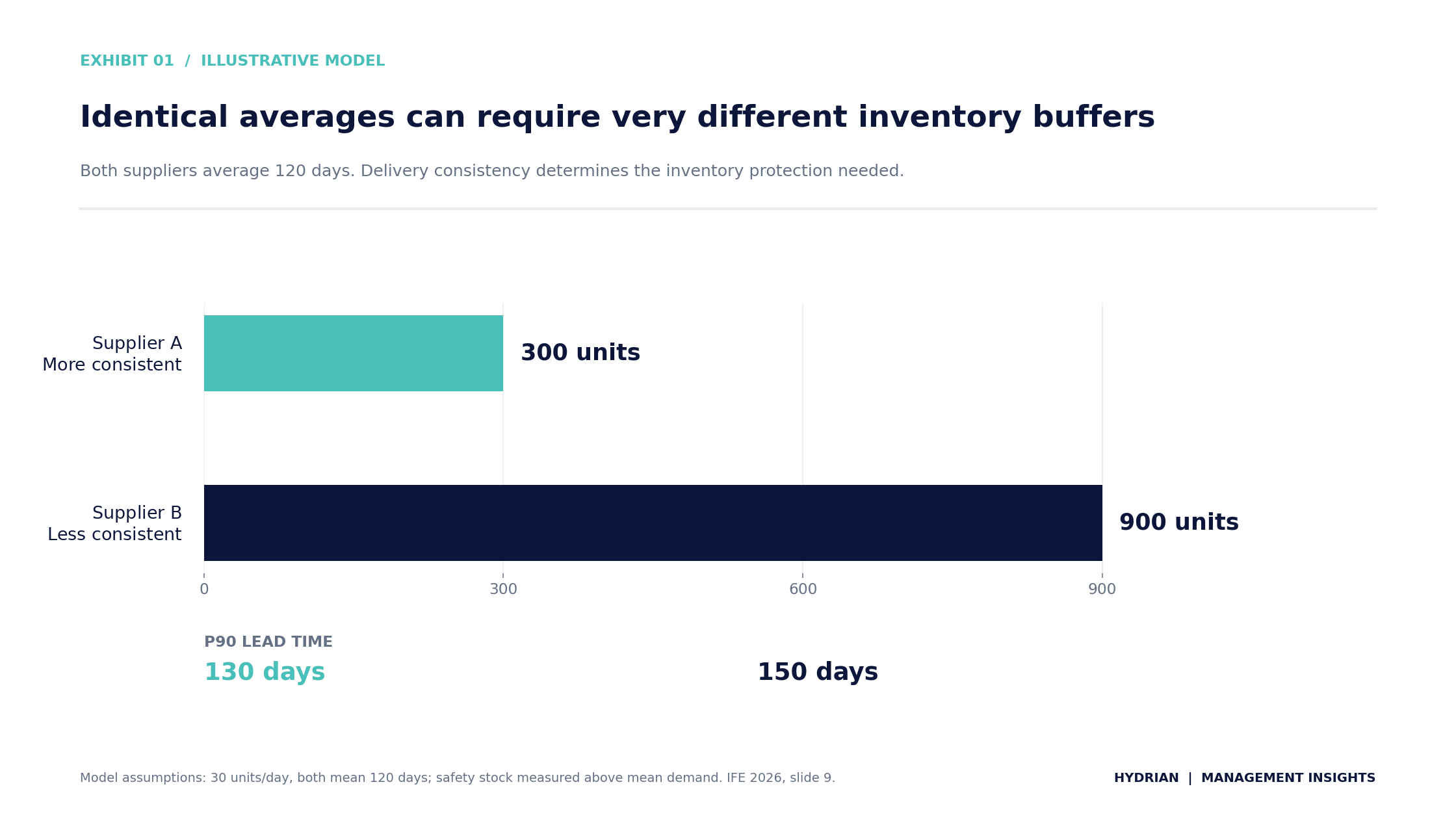
This illustrates a fundamental challenge in inventory management. Planning processes often depend on fixed estimates of demand, lead time and safety stock, even though the conditions influencing those estimates are inherently uncertain.
For distributors managing thousands of products across multiple suppliers and locations, that distinction has commercial consequences. It influences how much working capital is committed, which products remain available to customers, and how frequently purchasing teams must intervene when actual conditions differ from expectations.
Monthly forecast accuracy can conceal the demand exposure that matters to replenishment.
Consider two products with a four month replenishment period. For the first, monthly errors alternate between overestimating and underestimating demand by 400 units, cancelling out across the period. For the second, demand exceeds the forecast by 400 units in every month, creating a cumulative error of 1,600 units.
Both have the same monthly root mean squared forecast error of 400 units. Their monthly scores are identical; their cumulative inventory requirements are not.
Replenishment must protect against demand throughout the period before additional stock becomes available. For businesses ordering periodically, that protection period may also include the time between ordering opportunities. Monthly accuracy measures therefore need to be complemented by an assessment of cumulative demand uncertainty over the relevant horizon.
Even a perfect demand forecast cannot protect availability if replenishment arrives later than planned. The example below isolates that problem by holding demand constant while delaying the receipt.
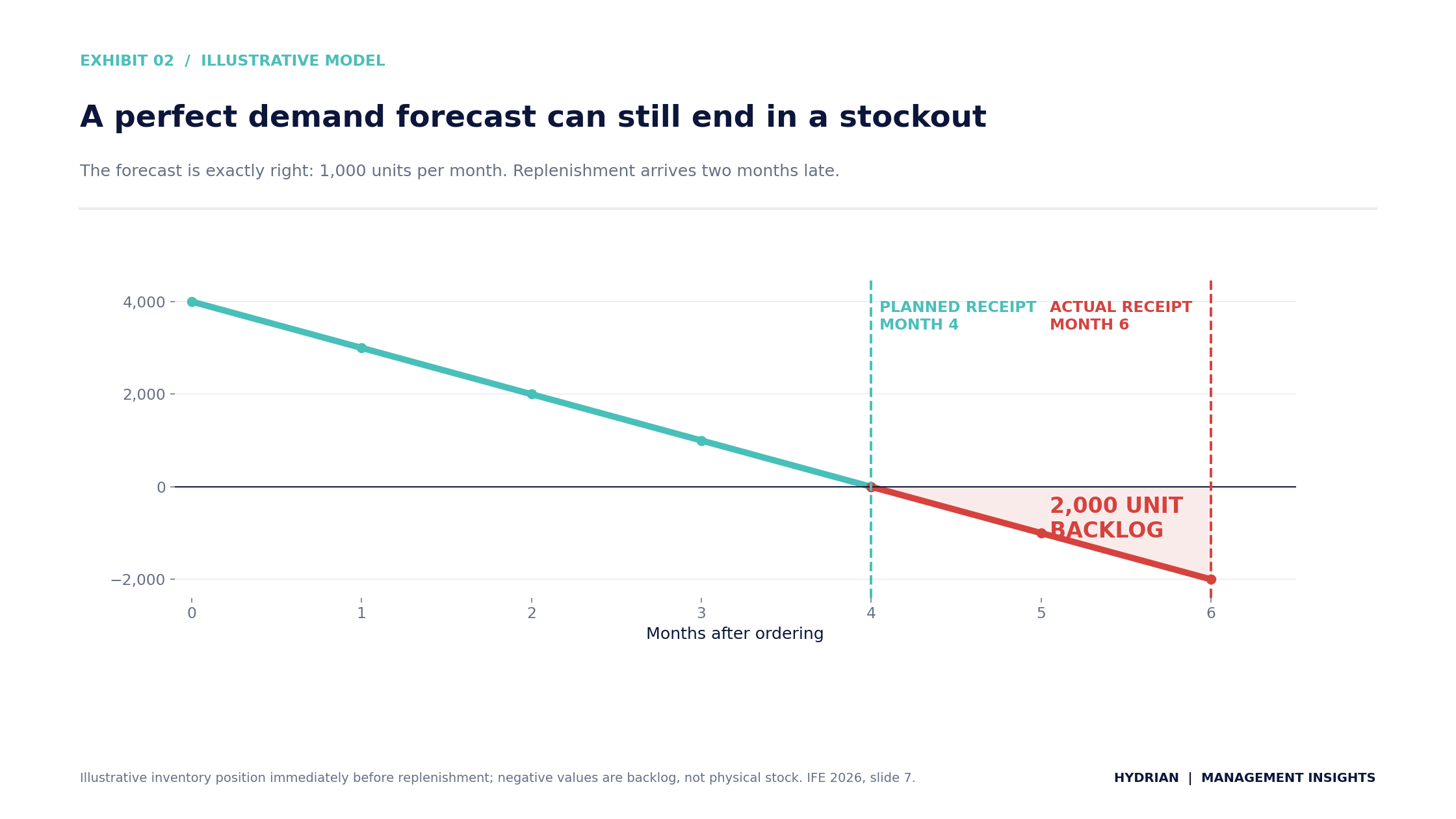
For planning purposes, lead time should extend to the point when stock is usable, not merely when it ships or arrives. Production, transportation, receiving and quality control can all influence that point.
Actual receipt histories should also distinguish comparable fulfillment paths. Supplier stocked products, made to order items and imports requiring local processing may behave differently, even when purchased from the same supplier.
The objective is not to assume the worst possible delivery time. It is to understand the likelihood and consequences of different outcomes, then select an appropriate level of protection.
Probabilistic forecasting estimates a range of possible outcomes and their likelihoods rather than a single expected value. One practical expression is quantile forecasting. A 90th percentile demand forecast is a level the model expects actual demand to stay at or below in approximately 90% of cases.
In the IFE presentation, an illustrative four month model with mean demand of 4,000 units produces a 95th percentile outcome of approximately 7,130 units. Under the assumptions of that model, this quantity covers 95% of cumulative demand outcomes over the specified lead time.
That is not equivalent to a 95% customer fill rate. Actual service performance also depends on ordering policies, available inventory and supplier performance.
The more useful question is not simply “How much demand do we expect?” but “What inventory is required to protect against different levels of demand uncertainty, and what will that protection cost?”
Both demand and lead time uncertainty matter. Stable demand may still require substantial protection if deliveries vary widely; more variable demand may be manageable if replenishment is frequent and dependable.
Probabilistic analysis cannot eliminate uncertainty or identify an economically optimal decision on its own. It provides better information with which to evaluate tradeoffs.
Inventory decisions are economic decisions made under uncertainty. This becomes especially clear when suppliers announce price increases or offer volume incentives.
In an illustrative eight month IFE scenario, a product sells 250 units per month and costs $10 today, rising to $11. The distributor can continue buying 1,000 units at a time or double its initial purchase to 2,000. The model also assumes a 5% monthly probability that the customer stops purchasing, a 30% annual holding cost, and a liquidation recovery of $4 per unit.
If demand holds, buying ahead offers a small net advantage. Incorporating customer loss risk reverses that result.
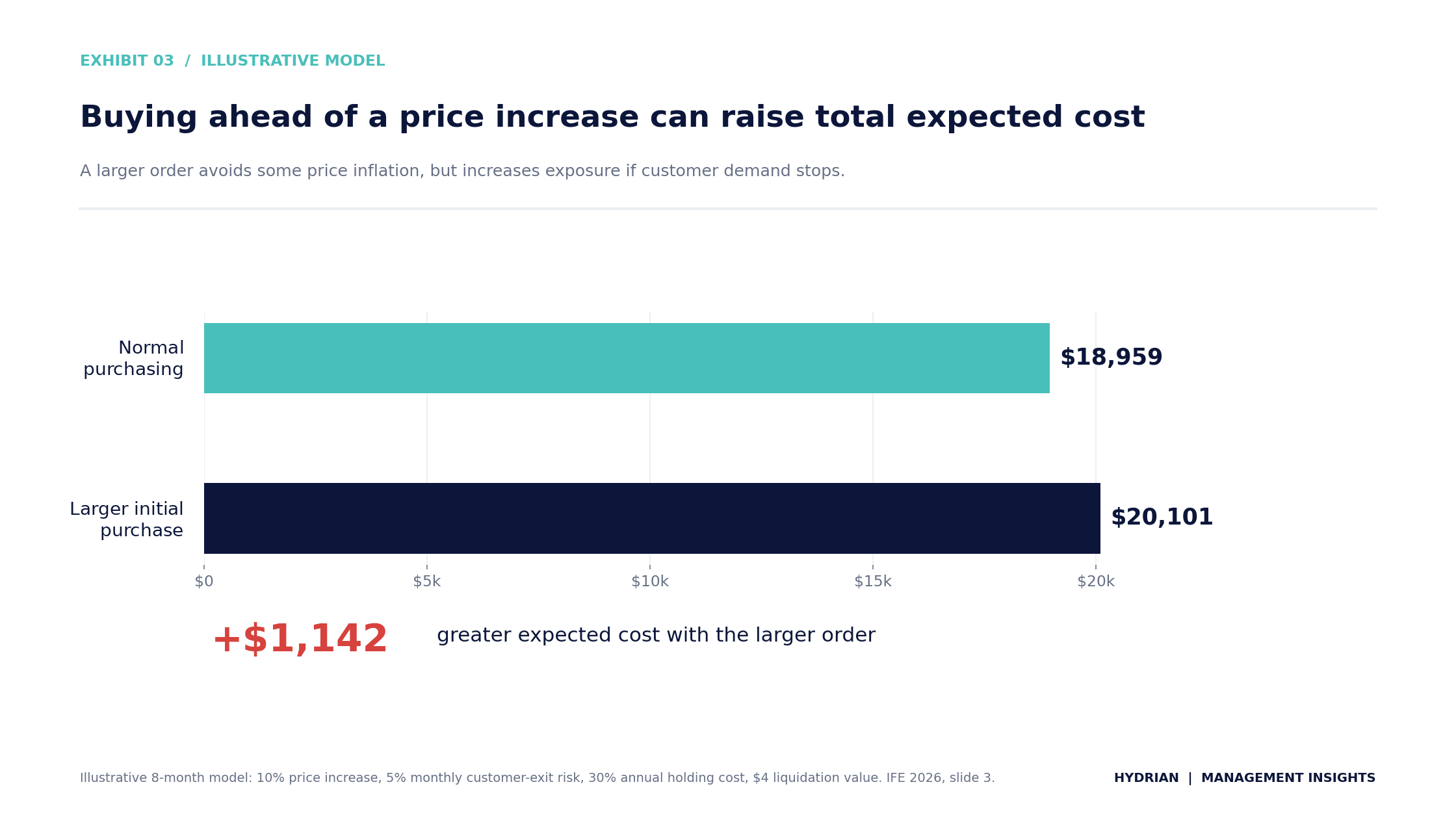
This is not an argument against forward buying. It may be entirely justified where demand is dependable, incentives are meaningful or interruption risks are unusually high.
Longer commitments also warrant scrutiny of obsolescence, changing customer requirements and the timing of cash exposure.
The best purchasing decision is not necessarily the one with the lowest unit cost. It is the one with the most favorable expected economic outcome, given the risks the business is prepared to accept.
Greater analytical sophistication does not mean every product needs a complex forecasting model. Stable items with dependable replenishment and established buying patterns can often be managed effectively using conventional methods.
The challenge lies in recognizing when an item’s characteristics make those assumptions less reliable. A distributor may encounter intermittent demand, occasional unusually large orders, volatile supplier lead times or disproportionate obsolescence risk.
These situations do not all call for the same solution. For an intermittent item, the first question may be whether to stock it at all. For an imported product, lead time variability may dominate. For an aging item, the economics of carrying and liquidation may be more important than the precision of a point forecast.
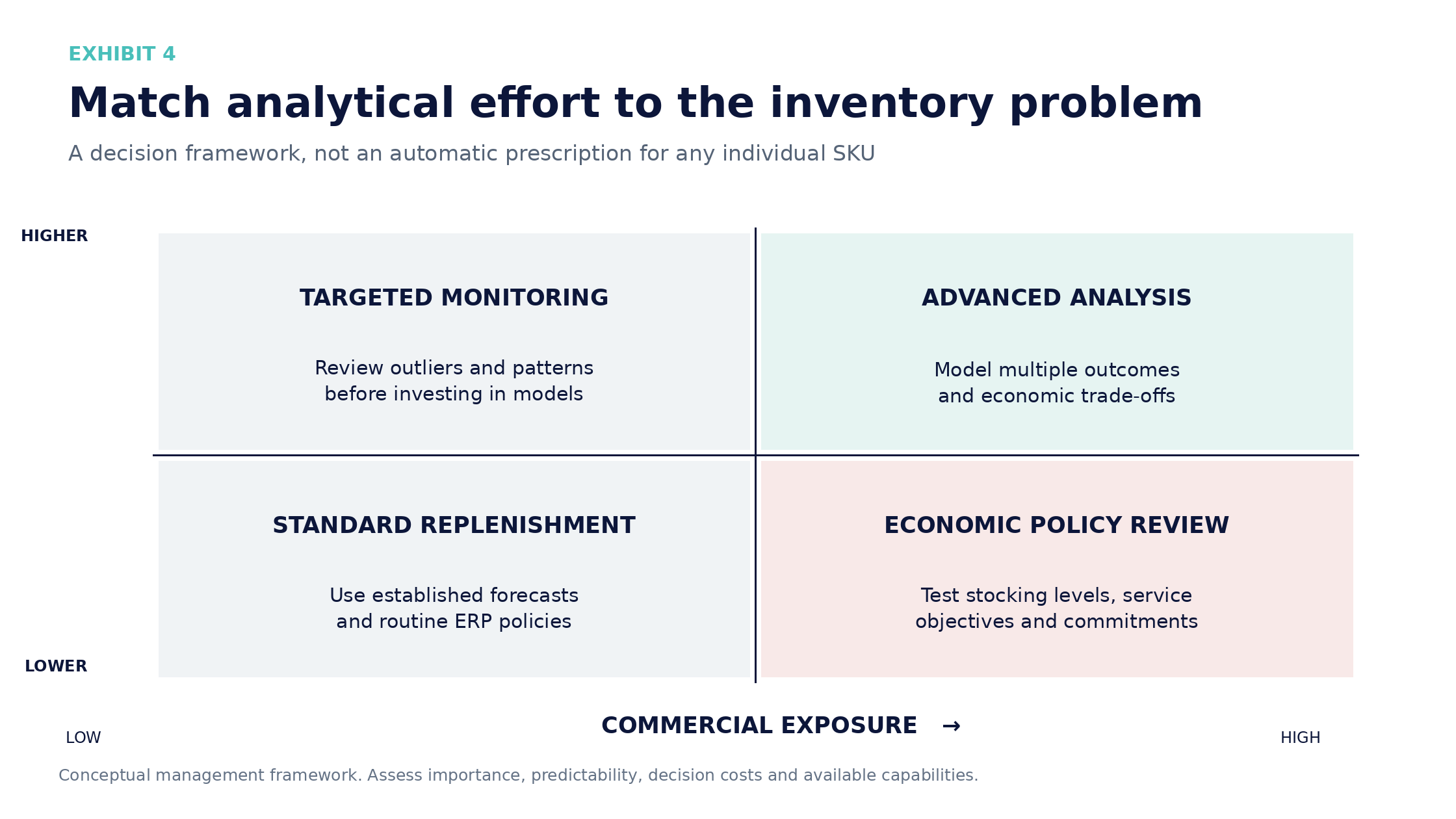
The sensible starting point is to identify products with recurring stockouts, persistent excess, frequent purchasing overrides or high recovery costs, then test whether existing assumptions still apply.
Sometimes a simple parameter change is enough. Other cases warrant scenario analysis, probabilistic modeling, revised stocking policies or changes in supplier management.
The management question is whether the organization has the data, analytical expertise and operating capacity to investigate difficult exceptions and sustain improvements. Depending on the business, that may involve internal specialists, additional tools, external expertise or a combination.
More sophisticated inventory analysis does not automatically require replacing established operational systems. ERP systems provide the framework for purchasing, receiving, replenishment and inventory transactions at scale. The opportunity is often to improve the assumptions and recommendations those processes use.
Josh Bartel’s IFE presentation demonstrates an illustrative technique. Historical supplier receipts are analyzed to estimate realistic lead time outcomes for comparable fulfillment paths. Demand is then evaluated over the replenishment horizon using quantiles, and the resulting analysis informs ERP inputs such as lead time, expected usage and reorder point.
In one example, a 120 day planning lead time and an adjusted usage rate of 1,500 units per month produce a 6,000 unit reorder point. The protection allowance is already reflected in the selected parameters, rather than being added through a separate safety stock quantity.
This is not a general recommendation to set safety stock to zero. Such an approach depends on the ERP’s replenishment logic and requires validation against the joint demand and lead time risks, service objectives and ordering practices. Some planning systems support these calculations more directly.
Purchasing recommendations must still account for minimum order quantities, price breaks, ordering frequency, transportation constraints and customer priorities. Planning assumptions also need ongoing review as conditions change.
Sophisticated forecasting has value only if it improves operational and economic performance. That requires a broader scorecard than forecast accuracy alone.
Immediate fill rates, availability and backorder duration describe the customer experience. Turns, aging stock and excess inventory describe capital efficiency. Liquidation losses, emergency purchases and expedited freight show some of the economic costs of decisions that fail.
These measures should be assessed together. Fill rates can improve simply because a business holds more stock. Turns can improve because the business cuts inventory while accepting more shortages. Neither change necessarily means the overall result is better.
The aim is a sustainable balance among customer service, inventory investment and total economic cost. That balance will vary by item, supplier, location and customer need.
The test of better inventory planning is whether it changes decisions and improves their consequences, not whether it produces a more elaborate forecast.
The purpose of better forecasting is not to predict the future with certainty. It is to make better decisions despite uncertainty.
Beyond Lead Time and Usage: Sourcing Fasteners Globally Without Surprises
Josh Bartel, CEO, Hydrian Inventory Optimization · International Fastener Expo 2026.
The original presentation provides the modeling assumptions, distributions and ERP examples discussed in this article.
Download Josh Bartel’s IFE presentation (PDF)
All numerical scenarios are illustrative models from the presentation, not reported Hydrian client results.


Get updates on the latest news across all core inventory-related processes.
Subscribe now!
Your email is safe with us, we dont spam.