
Rethinking demand planning in modern supply chains
Most supply chain teams treat forecasting as a technical challenge. The question is usually: what is the best model? But that framing misses the real issue.

Forecasting is not a model problem. It is a decision problem. The real challenge is translating demand patterns, business inputs, and operational constraints into purchasing actions. That is why a single forecasting approach almost always fails.
Most companies already have a forecasting process, even if they do not recognize it. In many ERP systems, the forecast is simply an average of recent demand. That number drives reorder points, purchasing quantities, and inventory targets.
This creates a hidden assumption: one method can represent future demand across the entire catalog. In practice, this is rarely true.
A distributor’s catalog contains stable high volume items, seasonal products, trending items, and sporadic long tail demand. Each behaves differently. Yet most organizations apply the same forecasting logic across all of them.
The result is predictable:
A simple average of recent demand is appealing because it is easy to implement. But it breaks down quickly in real operating environments. It does not capture seasonality. It lags behind trends.
It also assumes recent demand reflects future demand. That assumption fails when the business context has changed. The most common failure modes are:
These issues worsen as lead times increase. When purchasing must cover multiple months of demand, small forecast errors are amplified. Traditional methods also perform worst in the long tail, where most excess inventory resides.
Many organizations respond by moving to more advanced methods. Models like exponential smoothing, ARIMA, and ETS can handle trend and seasonality better than simple averages. In certain scenarios, they improve accuracy. But increased sophistication does not guarantee better outcomes. These models introduce more parameters and more complexity. It is common to gain precision in calculations while losing accuracy in results. No single model performs well across all demand patterns.
Forecast accuracy depends less on the model and more on the quality of inputs. Two of the most common distortions are stockouts and promotions. Stockouts suppress recorded demand. Promotions inflate it. If these are not corrected, every forecasting method will produce misleading outputs. A stockout period can make demand appear to drop to zero. A temporary promotion can create the illusion of sustained growth. A simple method applied to clean data will often outperform a sophisticated model applied to distorted inputs. Most forecasting initiatives fail here. The focus goes on selecting the right tool rather than ensuring the data reflects reality.
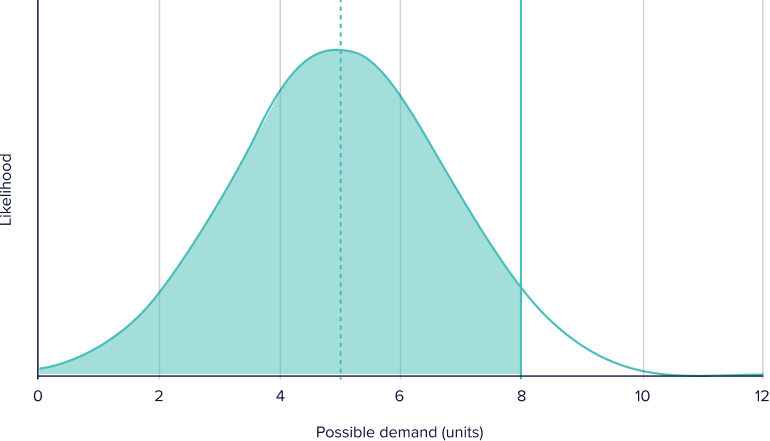
Recent advances in AI have introduced new forecasting capabilities. The most important shift is the ability to model uncertainty, not just produce a single point forecast.
Traditional methods produce one number: an average expectation. But inventory decisions are made with risk in mind. Modern approaches estimate the probability of different demand outcomes. Organizations can ask what inventory position supports a target service level and where overstock or stockout risk is concentrated.
This is a meaningful shift. Even so, the same principle applies. Advanced AI models produce poor results when inputs are flawed or business context is missing.
Organizations that improve forecast performance do not rely on a single model. They build a framework that aligns demand behavior with decision making. At a high level, this means:
The goal is not a perfect forecast. It is consistently better purchasing decisions.
If this reflects challenges you are working through in your own planning process, we would be glad to take a look. Reach out to start a conversation about where your current forecasting approach may be leaving performance on the table.



Get updates on the latest news across all core inventory-related processes.
Subscribe now!
Your email is safe with us, we dont spam.